
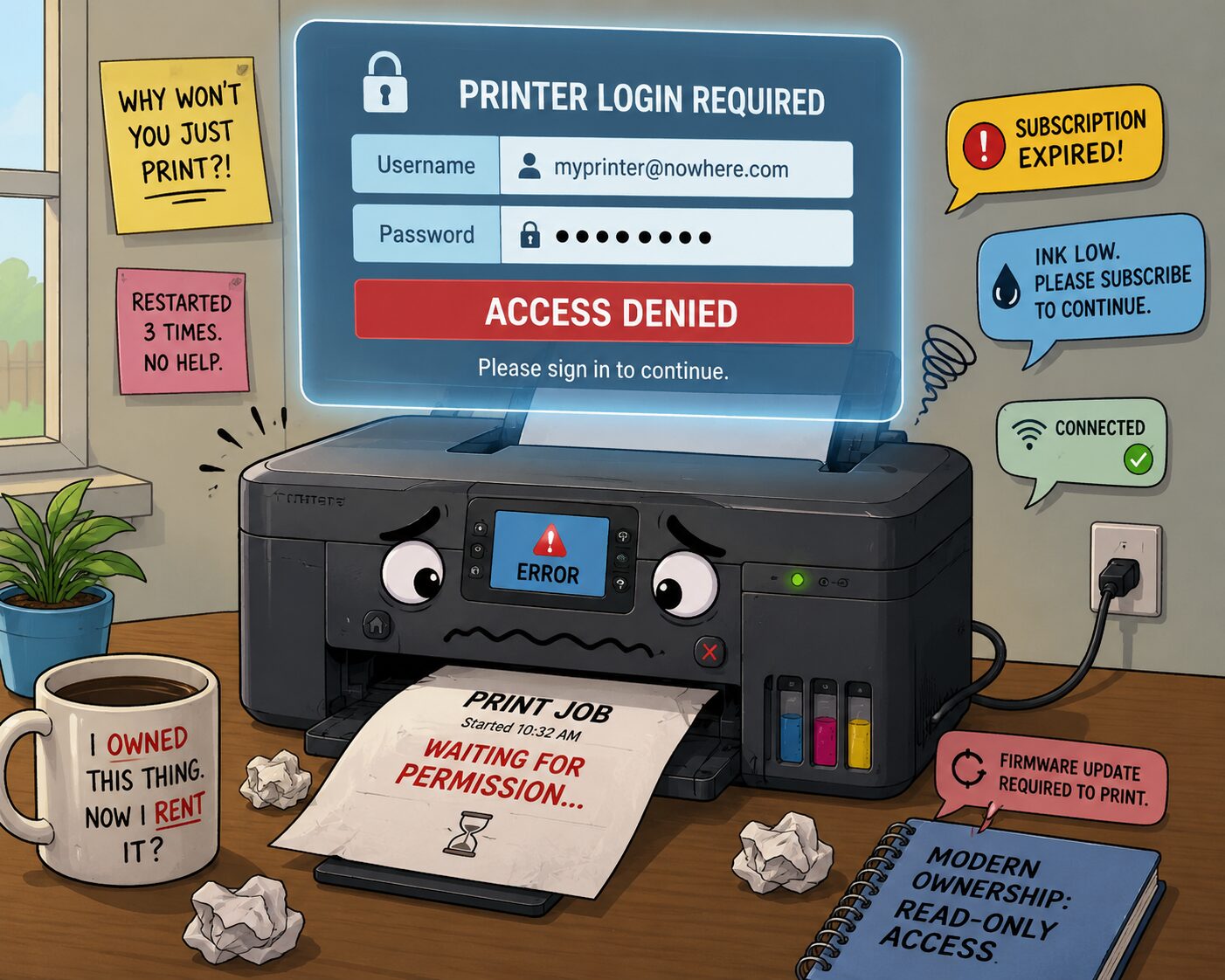
I never thought a printer would be the thing that pushed me over the edge.
A printer.
Not healthcare. Not streaming services. Not software subscriptions. A printer.
Recently, I sat down to print something on a printer that I purchased with my own money. It wasn’t a printer at work. It wasn’t a printer at a library. It was sitting in my house. Mine.
Or so I thought.
Instead of simply printing my document, I found myself dealing with account requirements, logins, and connectivity settings. At some point I stopped trying to solve the problem and started asking a different question:
Why does my printer need a relationship with a corporation after I’ve already bought it?
The more I thought about it, the more I realized the printer wasn’t actually the problem. The printer was just the thing that made the larger problem impossible to ignore.
We’ve quietly moved from an economy based on ownership to an economy based on access.
There was a time when buying something meant the transaction was over. You bought software, installed it, and used it for years. You bought a printer and bought ink when you needed it. You bought a television and expected it to work until it broke. The idea was simple. Once you paid for it, it belonged to you.
Today, ownership feels increasingly conditional.
Software requires subscriptions. Cloud storage requires subscriptions. Streaming services require subscriptions. Companies want accounts, recurring payments, and ongoing relationships long after the original sale has been made. More and more products seem designed around the idea that the customer should never stop paying.
From a business perspective, I understand why. Predictable revenue is attractive. Investors love it. Executives love it. It creates stability and makes future growth easier to forecast.
But from the consumer side, the experience feels very different.
What bothers me isn’t even the money. It’s the control.
Ownership used to transfer control from the seller to the buyer. Once the purchase was complete, the item was yours. You could use it, repair it, modify it, or ignore it for six months and come back later. It didn’t require permission. It didn’t require a monthly payment. It didn’t require maintaining an account.
Now many products come with terms, conditions, subscriptions, and restrictions attached. Companies remain involved long after the sale because they never really want the relationship to end.
That’s why the printer irritated me so much.
It wasn’t about printing.
It was about realizing that something as simple as a printer had become another example of a much larger shift. The printer was a reminder that many of the things we think we own are increasingly things we merely have access to.
Maybe that’s the future. Maybe younger generations won’t think twice about it because it’s all they’ve ever known.
But I still think it’s worth asking the question:
If buying something no longer means owning it, then what exactly are we paying for?
Leave a Reply